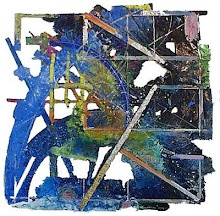
oil on panel, 38"h. x 36"w. x 3 3/4"d.
Showing posts with label nature as source. Show all posts
Friday, February 10, 2012
Monday, March 29, 2010
TWO WORKS FROM THE BEOWULF CYCLE (2002 & 2010)
Two works from the Beowulf Cycle:
"So Grendal Ruled in Defiance (2002) charcoal on paper":
"Wall Stead - In Heorot" (2010), oil on paper 12"h. x 30"w.:
A new friend wrote me saying these works reminded him of Rothko and Mondrian. Certainly. But I was hunting after something grimmer, with the teeth of wild dogs in the night - something in the silence after you hear the howling stop at midnight up on the ridge above my house; something old, very old, yet something still with us.
After all, this cycle of works was born out of that long time after September 11, 2001 when we all struggled with what terror means in our lives, some of us for the first time. The television repeated a thousand times over the long shot clips up the Manhattan canyons of the falling towers and the close up shots of frightened people fleeing wearing cloaks of the ashes of thousands of others. But the t.v. was impotent to tell of what it meant. That we each had to do ourselves. And we had to do this midst a storm of words generated by the media afterward, including the absurdity of our President exhorting us to just go out and fly and buy!
We don't see those t.v. clips much any more of course - that sense of horror can't be maintained. Through repetition we became numbed, but the sense of it drives deep within us into subterranean rivers. There it flows with our deepest fears and desires. Only later does it push up in new springs to the surface, where we drink of it in the form of revenge or hate, distrust, shame, alienation, estrangement and disaffection.
In the hollowed out days following the terrorist attack, I too struggled with some way to understand what had happened, and what, in its aftermath, was happening to my country. Of course, I went to the studio, picked up the deepest black stick of charcoal I could find, and began to draw.
A month and a half later my sister gave me a new translation of the 8th Century Anglo Saxon poem Beowulf by the Irish poet Seamus Heaney. It stunned me. Here was a clear sense of where to take this work: the starkly hewn way it carves and holds in constant balance line by line a palpable sense of light and dark, beginnings and ends, the ephemeral interlacing of humankind and nature, the way a line welds together a descriptive fact about nature with an evocation of human emotion, the way this energy is coiled and then released through succeeding lines like a driving wave. All these qualities resonated with my own confusion about what 9/11 meant, and suggested a "holding form" - that embryonic bud of a visual vocabulary, with which to explore toward some understanding.
It's now been over 8 years since that Tuesday morning in September. Some of us would like to forget. Some of us can't. As a country we are still trying to come to grips with what the presence of terror means in our lives. Our civic leaders have tried to turn it into a war - that way it is so much more understandable to a country gotten used to one war after another (after all, in my 65 years there have only been 10 when my country was not at war!). Our conflicts can't so easily be encapsulated I think except within the hollow pretense of newspapers, t.v., or on political stumps. The sources for our "wars" run fearfully deep within us - the Beowulf saga is a clear testament to that. We are at "war" with deep conflicts within ourselves, and we extend them not only to each other but to the natural world itself. It sometimes seems we are at war with the world at large, and the wall steads we have built to stand against disaster are falling all about us, like the mead hall in Beowulf's Heorot.
It's an old plaint and lamentation - the destruction of the world as we've known it. And in its destruction, the creation of something new.
Today I'm still exploring this work, still exploring my understanding of what it means through the work itself. It is called The Beowulf Cycle, and if you would like to see more examples just click here .
"So Grendal Ruled in Defiance (2002) charcoal on paper":
"Wall Stead - In Heorot" (2010), oil on paper 12"h. x 30"w.:
A new friend wrote me saying these works reminded him of Rothko and Mondrian. Certainly. But I was hunting after something grimmer, with the teeth of wild dogs in the night - something in the silence after you hear the howling stop at midnight up on the ridge above my house; something old, very old, yet something still with us.
After all, this cycle of works was born out of that long time after September 11, 2001 when we all struggled with what terror means in our lives, some of us for the first time. The television repeated a thousand times over the long shot clips up the Manhattan canyons of the falling towers and the close up shots of frightened people fleeing wearing cloaks of the ashes of thousands of others. But the t.v. was impotent to tell of what it meant. That we each had to do ourselves. And we had to do this midst a storm of words generated by the media afterward, including the absurdity of our President exhorting us to just go out and fly and buy!
We don't see those t.v. clips much any more of course - that sense of horror can't be maintained. Through repetition we became numbed, but the sense of it drives deep within us into subterranean rivers. There it flows with our deepest fears and desires. Only later does it push up in new springs to the surface, where we drink of it in the form of revenge or hate, distrust, shame, alienation, estrangement and disaffection.
In the hollowed out days following the terrorist attack, I too struggled with some way to understand what had happened, and what, in its aftermath, was happening to my country. Of course, I went to the studio, picked up the deepest black stick of charcoal I could find, and began to draw.
A month and a half later my sister gave me a new translation of the 8th Century Anglo Saxon poem Beowulf by the Irish poet Seamus Heaney. It stunned me. Here was a clear sense of where to take this work: the starkly hewn way it carves and holds in constant balance line by line a palpable sense of light and dark, beginnings and ends, the ephemeral interlacing of humankind and nature, the way a line welds together a descriptive fact about nature with an evocation of human emotion, the way this energy is coiled and then released through succeeding lines like a driving wave. All these qualities resonated with my own confusion about what 9/11 meant, and suggested a "holding form" - that embryonic bud of a visual vocabulary, with which to explore toward some understanding.
It's now been over 8 years since that Tuesday morning in September. Some of us would like to forget. Some of us can't. As a country we are still trying to come to grips with what the presence of terror means in our lives. Our civic leaders have tried to turn it into a war - that way it is so much more understandable to a country gotten used to one war after another (after all, in my 65 years there have only been 10 when my country was not at war!). Our conflicts can't so easily be encapsulated I think except within the hollow pretense of newspapers, t.v., or on political stumps. The sources for our "wars" run fearfully deep within us - the Beowulf saga is a clear testament to that. We are at "war" with deep conflicts within ourselves, and we extend them not only to each other but to the natural world itself. It sometimes seems we are at war with the world at large, and the wall steads we have built to stand against disaster are falling all about us, like the mead hall in Beowulf's Heorot.
It's an old plaint and lamentation - the destruction of the world as we've known it. And in its destruction, the creation of something new.
Today I'm still exploring this work, still exploring my understanding of what it means through the work itself. It is called The Beowulf Cycle, and if you would like to see more examples just click here .
Saturday, December 19, 2009
READINGS
One reads the morning sky in the manner of deciphering its pattern of form and movement so to chart the possibilities for one's own outer and inner day. The wind out of the east, low clouds and the feel of moisture in the air means the likelihood of rain, and that means no work possible in the vegetable garden if it's summer, no cutting firewood if it's winter, and so that opens up the possibility of inner immersion in work in the studio or up in the study.
Or, wandering through the woods I notice the track of a deer, and begin to read its story - how big a deer, male or female (if the back feet make tracks outside of the line of the front it's more likely to be a female I think), was it going fast or slow, was it heading single-mindedly toward some goal, or was it wandering (and therefore probably lazily grazing its way along - what's been nipped along its path?), how old (this morning? - the crumbled, heaved up edges moist and not dried out, or yesterday or last week - the edges dry and cracked - but has it been raining for several days keeping the track fresh for many days?).
Or, at the grocery store I am intently searching for something I've run out of, and happen into an old friend not seen for months. Our eyes meet and I read their face - the flicker of an eyelid, the cant of the head, the movement of the eyes - whether they meet me directly, or shift away in discomfort; the corners of the mouth either beginning to stretch into a smile or set in defense of something, reading the signs of well being, or not, of welcome, or not, of embarrassment, or the reaction traced there to my asking "how have you been?"
Or, I am standing on the front porch with the morning's first cup of tea in hand, waiting to address the new sun coming up over the trees to splash across the field below the house with radiant greens, and waiting too for how that makes me feel - comforted, confirmed, even positive about what I might accomplish this day.
Or, I'm in the studio, stirring paint, and stirring my perception, trying to read the nascent shape forming there into actuality - a smudge into the turning edge that catches the light just so,
Readings. And then there are the books. They are readings not much different than the ones above, in either breadth, depth, variety, or method. I am not a careless reader, but I do so in much the same way that I read other "sign" - the morning sky, an animal's track, some one's face, or a painting.
I've read much in my 64 years, a little of it valuable and a lot of it forgettable. Over the last 17 years it has narrowed mostly to reading over and over again the ones I know to be valuable because it has become increasingly hard to find new books that actually refresh and nourish - that encourage me to experience life in new and nourishing ways. The list of the ones I reread is short but rich -
Lewis Hyde's The Gift which I return to to be reminded of the true commerce of art
McLean's A River Runs Through It
Harry Middleton's On the Spine of Time ( both the carefully lucid parts and those when he slips into mere glibness - I've come to love his feet of clay as I would a friend's and don't much judge him for it)
John Haines' The Stars, The Snow, The Fire
Nelson's The Island Within
Paulsen's Clabbered Dirt, Sweet Grass
Barry Lopez's Arctic Dreams
John Inglis Hall's Fishing a Highland Stream
Suzuki's Zen Mind, Beginner's Mind
T.S. Eliot's Four Quartets (its elagaic quality every bit as forlorn as Samuel Barber's "Adagio"
Robert Bly's translations of Rilke's poems
Gary Snyder's A Place in Space
Christopher Camuto's Another Country
I have read all of these many times. I once came to the end of Camuto's Another Country and without hesitation simply turned to the first page and began again. It was like a really good painting in the way it continually nourished and revealed itself to me. Some of its enduring significance lies in its layering of stories - his personal narrative telling upon tales from the past that in turn tell upon stories of language, myth and culture, and that in turn upon a listening to what the land can tell us. On a few days, when my life seems exhausted of content, purpose, direction, or possibility, I turn to it for solace, and bathing myself in the rhythms of his thoughts and words, I find life turn brighter, and for me (I'm a painter after all) incandescent. And of course to say that its significance lies in its layering is to admit that what I look for in reading signs in the morning sky, a deer's track, a face in the crowd, or in a book, is the intricate layering of life itself that is true.
Or, wandering through the woods I notice the track of a deer, and begin to read its story - how big a deer, male or female (if the back feet make tracks outside of the line of the front it's more likely to be a female I think), was it going fast or slow, was it heading single-mindedly toward some goal, or was it wandering (and therefore probably lazily grazing its way along - what's been nipped along its path?), how old (this morning? - the crumbled, heaved up edges moist and not dried out, or yesterday or last week - the edges dry and cracked - but has it been raining for several days keeping the track fresh for many days?).
Or, at the grocery store I am intently searching for something I've run out of, and happen into an old friend not seen for months. Our eyes meet and I read their face - the flicker of an eyelid, the cant of the head, the movement of the eyes - whether they meet me directly, or shift away in discomfort; the corners of the mouth either beginning to stretch into a smile or set in defense of something, reading the signs of well being, or not, of welcome, or not, of embarrassment, or the reaction traced there to my asking "how have you been?"
Or, I am standing on the front porch with the morning's first cup of tea in hand, waiting to address the new sun coming up over the trees to splash across the field below the house with radiant greens, and waiting too for how that makes me feel - comforted, confirmed, even positive about what I might accomplish this day.
Or, I'm in the studio, stirring paint, and stirring my perception, trying to read the nascent shape forming there into actuality - a smudge into the turning edge that catches the light just so,
Readings. And then there are the books. They are readings not much different than the ones above, in either breadth, depth, variety, or method. I am not a careless reader, but I do so in much the same way that I read other "sign" - the morning sky, an animal's track, some one's face, or a painting.
I've read much in my 64 years, a little of it valuable and a lot of it forgettable. Over the last 17 years it has narrowed mostly to reading over and over again the ones I know to be valuable because it has become increasingly hard to find new books that actually refresh and nourish - that encourage me to experience life in new and nourishing ways. The list of the ones I reread is short but rich -
Lewis Hyde's The Gift which I return to to be reminded of the true commerce of art
McLean's A River Runs Through It
Harry Middleton's On the Spine of Time ( both the carefully lucid parts and those when he slips into mere glibness - I've come to love his feet of clay as I would a friend's and don't much judge him for it)
John Haines' The Stars, The Snow, The Fire
Nelson's The Island Within
Paulsen's Clabbered Dirt, Sweet Grass
Barry Lopez's Arctic Dreams
John Inglis Hall's Fishing a Highland Stream
Suzuki's Zen Mind, Beginner's Mind
T.S. Eliot's Four Quartets (its elagaic quality every bit as forlorn as Samuel Barber's "Adagio"
Robert Bly's translations of Rilke's poems
Gary Snyder's A Place in Space
Christopher Camuto's Another Country
I have read all of these many times. I once came to the end of Camuto's Another Country and without hesitation simply turned to the first page and began again. It was like a really good painting in the way it continually nourished and revealed itself to me. Some of its enduring significance lies in its layering of stories - his personal narrative telling upon tales from the past that in turn tell upon stories of language, myth and culture, and that in turn upon a listening to what the land can tell us. On a few days, when my life seems exhausted of content, purpose, direction, or possibility, I turn to it for solace, and bathing myself in the rhythms of his thoughts and words, I find life turn brighter, and for me (I'm a painter after all) incandescent. And of course to say that its significance lies in its layering is to admit that what I look for in reading signs in the morning sky, a deer's track, a face in the crowd, or in a book, is the intricate layering of life itself that is true.
Subscribe to:
Posts (Atom)