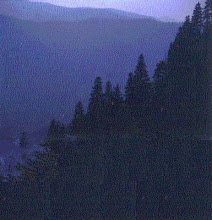
Reflections and notes on the relationship of art to nature and of nature to art from along Warwoman Creek, in the Blue Ridge Mountains of Katuah Province of Turtle Island, where the light, the dark, the seasons, the time of deep past, deep present and deep future all mix in alchemal mists to reveal and hide and transform these slopes, shaded coves, bright rivers, deep forests and me, and together sustain me and my art.

Showing posts with label painting. Show all posts

Wednesday, July 6, 2011

NEW WORK

Body Tree, 2011
Oil on canvas, 40"h. x 30"w.


Seeing Through, 2011
Oil on canvas, 29"h. x 32"w.


The Mountain Opens to Speak Its Name, 2011
Acrylic on polyester, 82"h. x 78"w.

Monday, April 5, 2010

OF DAFFODILS AND WINTER WORK

"...one might be walking in the forest and come across a patch of daffodils in bloom. This, she said, would likely mark an old homestead, where a woman, seeking to brighten her family's life, would have planted some bulbs. Since daffodils can live 100 years, they could well be the only visible reminder that someone once lived there."  This quote from Marie Mellinger, a local friend wrote me on reading my poem "Will You Be The One?" and being reminded of one of Marie's springtime newspaper columns from back in the late 1980's.

Yes, the daffodils have bloomed. Here along the northern foot of Rainy Mountain they only bloomed a few days ago. Let me say it again because it sounds so nice - the daffodils have bloomed! - such good mouth fun to say!

It has been a long, cold winter this year here in the Southern Appalachians. During this winter a poem I wrote in September,"What's Needed," unexpectedly became prophetic and a daily mantra for me:

WHAT'S NEEDED

What's needed
is water
and dark

moving to a time
as slow as roots

in a well

where silvered fish
swim

in a dream
of knowing

not caught
but foreseen.

This winter there was almost nothing foreseen, and a lot of not knowing. The poem stayed with me all winter as a kind of hope.

Wise friends counseled me to go slow, to take in the winter, and there to listen and let germinate. So the paintings and the poems grew slowly, uncertainly, and often not at all. Their shapes shifted from day to day, as if drifting in a cold mountain mist. But nothing was foreseen. It was a long winter.

On those cold days, somber winter colors drew my gaze deeper and deeper into the greyed landscape to catch only the ephemeral scent of some richer color. Hiding beneath the mauves I began to see, or only imagined, the purples, and sunk beneath the ruddy ochres the yellows, and beneath the burnt siennas the reds. These were almost just a sliver of memory, and perhaps only an imaginative hope of re-conjuring of them.

The paintings and poems came slowly like that too. At times I wondered, in a kind of sadness, if there would ever be any more. But there were. If I had only payed more attention to the springs up on the mountain, which continued all winter to bubble up from old root ways and make wandering passages through the rimes of ice. Then I would have known they would come:

"Winter Wall," oil on paper:


"Candlemas" oil on paper:


"Wall Stead - in Heorot," 2010, oil on paper:


And then, curiously, near the end of winter, just as bright green shoots of daffodils broke ground, old left off with paintings, flush with summer colors, caught my eye with renewed promise:

"Summer Mountain,: 2007-2010, oil on wood panel
53 1/2"h. x 75"w. x 1 3/4" d.:


"St. Molin's Well," 2007-2010, oil on wood panel,
40"h, x 40"w. x 1 3/4" d.:
:


And then the poems unlocked themselves:

IMAGINE A GARDEN MADE

Imagine a garden made
not grown. Stakes first
driven into the ground
should do for roots.

Then lattice strips
and papery leaves
stapled to the fret of this
painted green in advance.

No need of water or time.
Braces added later
will hold up the higher fruit -
tennis balls on strings
might do.


Addendum:

Imagine a life made
not grown. Ideas first
driven into dreams
should do first for principles.

Then a geomancy
of facts and figures,
nailed to cross timbers
of thoughts, indexed and sorted
by a thesaurus of death.

No need of spirit or heart.
Theologies added later
will prop up desire -
dogmas and litanies
in ledgers might do.


HE ASKED IF EVER
        (a variation on some last lines by W.S. Merwin)

My hands
greasy with paint
he asked

how can you ever
be sure what you paint
is any good
at all.

I am old
and grimy with the oil
and rags and bones
of my heart.
I say
you can't. You die
without ever knowing
if anything was
any good
at all.

If you
have to be sure
don't paint
I say
wiping my hands
on an old rag
of a dream.


THE LAWS OF FALLING BODIES

Galileo did in Padua find
the laws of falling bodies
dropping lead weights, not birds or dreams.

But as he should have known
all things issue from their source
the sun: each proton

and person descends along
its own particular and precise
frequency. Singing

each falls into matter
with its own signature
still echoing. And here

just here
this unerring lightness
of being arises.


THE WILD NETTLE

This wild nettle
that is Creation
trembles.

My touch and words
pinch at the knot there
that is knowing
and not knowing.


THIS STORM, THIS ROCK, THIS LEAF

This storm
this rock
this leaf

torn loose
to wander and fall
could be any one's life.

This wilderness
enfolding each simplicity
might comprehend
such a life

completely.

It carries a gift
and when they wake
they wake into it -

those who live by dreams
they who live by voices
we may never hear.

This house
not made by hands
is invisible.


THINGS TO SAY (while there's still time)
                               - for Lynn

I love you.
The dogwood just opened.
Spring remembers for us.
This war can still end
and there can be peace.
Wild violets grace the yard.
The cold tonight will seep to the root.
That 'yes' and 'amen' mean the same thing.


And then, on a bright still day, the forest all grey and standing in an ancient chorus around this clearing, there were "Daffodils," their new brightness still clinging to the frets of somber winter tones, a monoprint, oil on paper, 30"h. x 22"w.:

Monday, March 29, 2010

TWO WORKS FROM THE BEOWULF CYCLE (2002 & 2010)

Two works from the Beowulf Cycle:

"So Grendal Ruled in Defiance (2002) charcoal on paper":


"Wall Stead - In Heorot" (2010), oil on paper 12"h. x 30"w.:


A new friend wrote me saying these works reminded him of Rothko and Mondrian. Certainly. But I was hunting after something grimmer, with the teeth of wild dogs in the night - something in the silence after you hear the howling stop at midnight up on the ridge above my house; something old, very old, yet something still with us.

After all, this cycle of works was born out of that long time after September 11, 2001 when we all struggled with what terror means in our lives, some of us for the first time. The television repeated a thousand times over the long shot clips up the Manhattan canyons of the falling towers and the close up shots of frightened people fleeing wearing cloaks of the ashes of thousands of others. But the t.v. was impotent to tell of what it meant. That we each had to do ourselves. And we had to do this midst a storm of words generated by the media afterward, including the absurdity of our President exhorting us to just go out and fly and buy!

We don't see those t.v. clips much any more of course - that sense of horror can't be maintained. Through repetition we became numbed, but the sense of it drives deep within us into subterranean rivers. There it flows with our deepest fears and desires. Only later does it push up in new springs to the surface, where we drink of it in the form of revenge or hate, distrust, shame, alienation, estrangement and disaffection.

In the hollowed out days following the terrorist attack, I too struggled with some way to understand what had happened, and what, in its aftermath, was happening to my country. Of course, I went to the studio, picked up the deepest black stick of charcoal I could find, and began to draw.

A month and a half later my sister gave me a new translation of the 8th Century Anglo Saxon poem Beowulf by the Irish poet Seamus Heaney. It stunned me. Here was a clear sense of where to take this work: the starkly hewn way it carves and holds in constant balance line by line a palpable sense of light and dark, beginnings and ends, the ephemeral interlacing of humankind and nature, the way a line welds together a descriptive fact about nature with an evocation of human emotion, the way this energy is coiled and then released through succeeding lines like a driving wave. All these qualities resonated with my own confusion about what 9/11 meant, and suggested a "holding form" - that embryonic bud of a visual vocabulary, with which to explore toward some understanding.

It's now been over 8 years since that Tuesday morning in September. Some of us would like to forget. Some of us can't. As a country we are still trying to come to grips with what the presence of terror means in our lives. Our civic leaders have tried to turn it into a war - that way it is so much more understandable to a country gotten used to one war after another (after all, in my 65 years there have only been 10 when my country was not at war!). Our conflicts can't so easily be encapsulated I think except within the hollow pretense of newspapers, t.v., or on political stumps. The sources for our "wars" run fearfully deep within us - the Beowulf saga is a clear testament to that. We are at "war" with deep conflicts within ourselves, and we extend them not only to each other but to the natural world itself. It sometimes seems we are at war with the world at large, and the wall steads we have built to stand against disaster are falling all about us, like the mead hall in Beowulf's Heorot.

It's an old plaint and lamentation - the destruction of the world as we've known it. And in its destruction, the creation of something new.

Today I'm still exploring this work, still exploring my understanding of what it means through the work itself. It is called The Beowulf Cycle, and if you would like to see more examples just click here .

Monday, February 15, 2010

PAINTINGS & POEMS: A RIVER RUNS THROUGH THEM

This year, as the year and I and the dim sun turned, I made a book of poems and paintings; small enough to fit in the hand and large enough to share - ten poems, some new and some a little older, and eleven new watercolor paintings created to converse with the poems - a thin keen clean volume.

I think a kind of river runs through it.

As I could only manage an edition of 25 copies printed on my aging, mean tempered, and perversely quarrelsome HP ink jet printer, here are some selections.

As you look through this selection I invite you to ponder the following possibility:

Paintings and poems share something important -
a concentrated form of paying attention -
paying attention to what IS!
And what is, is both moving and still.

Paintings are still and yet move in our minds,
thoughts and feelings.

Poems are always moving in our minds,
our thoughts, our feelings,
and yet they are always forming pooling echoes
of the still and eternal present.

Paintings and poems - two sides of one coin,
and a river runs through it.


DAWN:


Dawn,
with lighted fingers
stitches a delicate thread
an amber line of ridge against the night

- then begins
to hem
the greening march of trees
down along the still dark creek

- and begins
to mend
out of what might have been
this day together

- once again
such prescient
marvelous
needlework!

- surely sewn
we together
out of wonder
this world.


WE ARE ALWAYS DREAMING:


We are always dreaming,
the good life, the bad life,
the life not lived.

In our ceremonies
we mark our bodies
with the signs of our dreams:
flames and crosses and circles.

Wearing our dream marks
we carry our whole lives
into the country of our days.

We must do this - keep it up,
this dreaming into our waking country,
keep it going, keep it safe,
even into the desert of our selves.


OUR MEMORY OF IT:


Our memory of it,
like Half-moon River Marsh
in late summer or early fall,
a sweetened breeze
coming off the sea

its light a silvering of the past,
the tide of it
washing in and then back
again. That day

down on the sunlit dock,
the children singing.

Those times - more than enough
to burst the heart open.

Too much of it to hold now,
yet too little of it to ever keep.


WE ARE ALL:


We are all vagabonds
on this earth, wanderers
with hungry hearts

looking for a home
we never had.

At night we gather
to distant fires
of scavenged wood and brush

stir the ashes there
and seek answers in the stars.

In ceremony
we mark our faces
with our dream of want -

flames and crosses and circles.

And we carry this into all our days
even into the desert of our lives

dreaming into each new country
our home again.


WHAT'S NEEDED:


What's needed
is water
and dark

moving to a time
as slow as roots

in a well

where silvered fish
swim

in a dream
of knowing

not caught
but foreseen.


A RIVER RUNS THROUGH THIS:
-for Bill McLarney


A river runs through this
Blacksnake sliding under Jewelweed
flushing Robin surprising Blue Jay
screeching over mirror striding Water Spider
reflecting wheeling Red Tailed Hawk calling:
where are you where are you to Lizard
scrambling across old barn wood parched in the sun
gliding over Otter slipping from rock into water
flashing by Golden Shiner scurrying toward Sculpin
nuzzling mud beneath silver racing Gilt Darter
darting past Bloodroot stemming into whitened flower
from the moss blanketed bank shouldering
into the stream as rainbowing Kingfisher
alights and makes the heart stop
and the river run through it.

A river runs through this
a poem where I am swimming around you
composing dreams about rivers
to all of you swimming about me
who are dreaming poems about yourselves
and I am coming to a place and don’t have the words
and someone else tells me the next one
and so it goes, generous,
the swimming and the dreaming and the telling
and the river runs through it

you and me,
this river runs through us.


SPIRIT SALSA - for Lynn:


Come and dance
you and me
come and go

around and back
and come again
all the patterns flying

there is no you
there is no I

and we two are
but a fold in time.

Come!

and dance between
all the patterns making
and unmaking

you and me now

step again
with me now
into this always

changing
moving
desiring

and then just there
and then
where it calls us back

into the circle
where letting go
is holding on

to where
the meaning always is
moving on

to a desire
that brings to life
and the dance between

you and me
always making
come and go.

My love!
Come and dance with me!


TRINITY:


1.
This stream
is right here somewhere where I am ten
and running naked under the old oaks
along Trinity River.

2.
And this one
flows in my blood
with a generosity I can
in no way account for now.

3.
And this one
like a breath is slow
and long, smooth and deep,
even and balanced by that other,
the heart still flung open.


LESSON #2:
HOW TO LIVE A LIFE ON THIS RIVER:


Reach out
beyond yourself so far
you have to let go
of the shore.

Gather in what happens here.

Then pull back
against the undertow.
Sit on the beach
and examine your hands.

Most days
you will only be left
with flecks of mica broken
pieces of shell, the sands
of rock and time.

But sometimes
you will be left with fiery bits
of starlight.

These are yours.

So enter a river,
a poem, a church, a conversation
anywhere. Swim around
listen for the resonance
in the waves, for the motion
in the current.

Let each filament of river
weave into your breath.

Then say what happens here.
Know that we all are listening.

A river, a poem, a church,
a conversation, even a breath
it’s all a great river. I’ll meet you there.


Saturday, December 19, 2009

READINGS

One reads the morning sky in the manner of deciphering its pattern of form and movement so to chart the possibilities for one's own outer and inner day. The wind out of the east, low clouds and the feel of moisture in the air means the likelihood of rain, and that means no work possible in the vegetable garden if it's summer, no cutting firewood if it's winter, and so that opens up the possibility of inner immersion in work in the studio or up in the study.

Or, wandering through the woods I notice the track of a deer, and begin to read its story - how big a deer, male or female (if the back feet make tracks outside of the line of the front it's more likely to be a female I think), was it going fast or slow, was it heading single-mindedly toward some goal, or was it wandering (and therefore probably lazily grazing its way along - what's been nipped along its path?), how old (this morning? - the crumbled, heaved up edges moist and not dried out, or yesterday or last week - the edges dry and cracked - but has it been raining for several days keeping the track fresh for many days?).

Or, at the grocery store I am intently searching for something I've run out of, and happen into an old friend not seen for months. Our eyes meet and I read their face - the flicker of an eyelid, the cant of the head, the movement of the eyes - whether they meet me directly, or shift away in discomfort; the corners of the mouth either beginning to stretch into a smile or set in defense of something, reading the signs of well being, or not, of welcome, or not, of embarrassment, or the reaction traced there to my asking "how have you been?"

Or, I am standing on the front porch with the morning's first cup of tea in hand, waiting to address the new sun coming up over the trees to splash across the field below the house with radiant greens, and waiting too for how that makes me feel - comforted, confirmed, even positive about what I might accomplish this day.

Or, I'm in the studio, stirring paint, and stirring my perception, trying to read the nascent shape forming there into actuality - a smudge into the turning edge that catches the light just so,  

Readings. And then there are the books. They are readings not much different than the ones above, in either breadth, depth, variety, or method. I am not a careless reader, but I do so in much the same way that I read other "sign" - the morning sky, an animal's track, some one's face, or a painting.

I've read much in my 64 years, a little of it valuable and a lot of it forgettable. Over the last 17 years it has narrowed mostly to reading over and over again the ones I know to be valuable because it has become increasingly hard to find new books that actually refresh and nourish - that encourage me to experience life in new and nourishing ways. The list of the ones I reread is short but rich -

Lewis Hyde's The Gift which I return to to be reminded of the true commerce of art
McLean's A River Runs Through It
Harry Middleton's On the Spine of Time ( both the carefully lucid parts and those when he slips into mere glibness - I've come to love his feet of clay as I would  a friend's and don't much judge him for it)
John Haines' The Stars, The Snow, The Fire
Nelson's The Island Within
Paulsen's Clabbered Dirt, Sweet Grass
Barry Lopez's Arctic Dreams
John Inglis Hall's Fishing a Highland Stream
Suzuki's Zen Mind, Beginner's Mind
T.S. Eliot's Four Quartets (its elagaic quality every bit as forlorn as Samuel Barber's "Adagio"
Robert Bly's translations of Rilke's poems
Gary Snyder's A Place in Space
Christopher Camuto's Another Country

I have read all of these many times. I once came to the end of Camuto's Another Country and without hesitation simply turned to the first page and began again. It was like a really good painting in the way it continually nourished and revealed itself to me. Some of its enduring significance lies in its layering of stories - his personal narrative telling upon tales from the past that in turn tell upon stories of language, myth and culture, and that in turn upon a listening to what the land can tell us. On a few days, when my life seems exhausted of content, purpose, direction, or possibility, I turn to it for solace, and bathing myself in the rhythms of his thoughts and words, I find life turn brighter, and for me (I'm a painter after all) incandescent. And of course to say that its significance lies in its layering is to admit that what I look for in reading signs in the morning sky, a deer's track, a face in the crowd, or in a book, is the intricate layering of life itself that is true.