Honor Woodard’s “Prescribed Burn”in her upcoming book: Upon Reflection: New Landscapes, Ancient Lands
A flux of events brings an image into being. A forest fire and an artist’s explorations of mandala imagery get folded into the construction of an image that goes out into the world to make a living for itself. The still and unmoving reality of this image no longer just chronicles these events, but remains to fix something beyond that eventfulness and holds it in place; no longer as a journalistic document, but by a consequent folding and refolding of the particulars of these events into a particular fabric of harmony. Not a quiet harmony. No, not that at all! But a harmony with enough visceral strength to perhaps hold up the world. In such a way an image can touch us.
Our images tell us much about both the world around us as well as the world inside us. Whether they are the images we are drawn to or repelled by, or whether they are the images we make, they all fix an eternally moving life. They tell us that within the flow of creation there is order, within constant change and transformation there is pattern, that within time there is a permanence. We take in an image of the world around us and see how it fits with our inner experience of ourselves. We take an inner image and project it upon the world to see how it fits. Of course, the two can't easily be disentangled. One reflects the other. It is unlikely the two can ever be disentangled. But in the intertwining we locate ourselves in relationship to the world around us, and the world in relationship to ourselves. In this way Honor Woodard's image
"Prescribed Burn," is a compelling image.
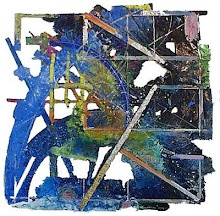
First, it draws us to it by its forceful symmetry; at first, like a face by its bilateral symmetry. But then we realize this scene is a reality that has been folded four times, and thus draws us into a very different relationship to the landscape and the world.
We don't expect this from a landscape. Whether in a painting, a photograph, or direct observation, we normally expect a scene to unfold before us - like a carpet unrolled from foreground through middle, to background. These are the characteristics of a European landscape tradition established long ago in the eighteenth century. It is a particular culturally shaped view of land - that it is to be properly surveyed from a distance and remove, and that one moves through it linearly (from foreground thru middle toward the horizon). Thus it tells us of the world inside us - just how we organize experience within our minds and thoughts, how we can observe a whole bundle of thoughts and ideas from a rational remove.- we say we have to “stand back to see the whole picture” of some problem.
When we simply pull off the highway at a scenic look out, we are rereading this prescriptive 18th century European way of relating to the landscape, the land, nature, and the whole natural world - at a remove and distance, and in linear progression and a one point perspective. When we snap a picture of this scene to save its memory, the lens we employ has been ground specifically to shape this one point perspective. One has only to peruse the images of landscape in other cultures to see how richly diverse are the ways to relate to landscape, and to ourselves. An Apache storyteller will tell you “the plants, rocks, fire, water, all are alive. They watch us and see our needs. They see when we have nothing to protect us, and it is then that they reveal themselves and speak to us.”
Unfortunately most of these ways are no longer available, they are either dead, or rapidly being pushed to extinction
So it can matter greatly, and directly, in our lives just how and where we locate ourselves in this world, and how and where we locate our inner world in relation to the outer world. In 1991 Wendell Berry eloquently described what happens when we believe in “
fictive coordinates.” like those of linear perspective- we lose control over ourselves as well as the controls of nature. Honor’s “Prescribed Burn” presents a strongly “worded” opposition to this European tradition.
In “Prescribed Burn” Honor Woodard has transformed landscape into a surrounding symmetry of coordinates strongly provoking a Rorcharch response in us, and thus purposefully pushing landscape into
inscape. At first, "Prescribed Burn" unfolds much as a European alter piece. Such an alter piece unfolds to reveal a hierarchical organization of space, in careful steps from vile earth upward through a social reality to a heavenly one, thus revealing its own culturally shaped view of the ultimate reality. But Honor's four fold symmetry does not allow us to move back to survey or to lead us upward toward a higher reality - the tripartite universe of European theology and culture, with God over Man and Man over nature. Honor’s quadripartite universe relocates ourselves within a constantly unfolding and refolding relationship. The U.S. Forest Service prescribed burn took place on what was once Cherokee land in N.E. Georgia. They saw this land in their own terms, and they too understood the universe as quadripartite. For them the sky, “Galun'lati” is a stone arch, part of the earth, not a transcendent reality. Their four cardinal directions located a place that extended itself into the three additional sacred directions of earth, human, and spirit.
"Prescribed Burn's" insistent folding focuses us there within that place, each part mirroring another, each part reverberating with an over all pattern, just the way a spider’s web does. Two mature Pine trees, secure as architectural columns, scarred by fire, stand triumphant on solid earth and hold up a roof, not of heaven, but of earth again itself.
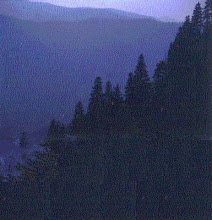
And what are the circumstances from which this scene unfolds? It happens to be not a symbolic vision, but a particular event in a particular time and place: the U.S. Forest Service's frequent attempt through "controlled burning" to reset the natural forest process of growth, in effect their attempt to domesticate both forest and fire. Honor's image is based on her photographic document of such a prescribed burn in North Georgia. Ash and char permeate that scene. But the evidence of destruction by fire throughout becomes folded into a perfect and still harmony. The two Pine trees could be a gate for us, but it is a narrow one, and the two stout trees present us with two formidable guardians.
Beneath this controlled, prescriptive burning of a forest floor, lurks a deeper circumstance. Fire in a forest is terrifying. We've known this for millennia. It is wildness in its rawest expression. It is a wild beast, a destroyer of life. What we've always feared in a wolf's gaze is multiplied many times by a forest fire.
Though a flux of events brought this image into being - a forest fire, an artist’s exploration of imaging, the folding of these into an artist’s experience of what a pattern in life does reveal, the image itself now lives in our world among us. We can’t say it never was, or that it was just a passing figment of imagination or fancy.
We need to know of this, and learn from it. It’s obvious to me that many of our most entrenched images about the world and ourselves have gotten us into great trouble. The recent ecological disaster in the Gulf of Mexico is. by all engineering and scientific expert accounts, far beyond our ability to either prevent or repair. Such news for our species is grim. Perhaps we can’t save our natural environment without first saving something in ourselves - some way to re-inhabit this world by coming to it with a renewed image of it and of ourselves. The experience of art offers one step in this direction - an art that encourages us to imagine another image of our relationship to nature. This is what Honor Woodard’s “Prescribed Burn” does in fact summon us to - a re-evaluation of that moment, which could be any moment, a revaluation of our relationship to the world around us and within us. It’s what we need to know here and now.
To learn more about Honor Woodard's work just go to:
http://www.blurb.com/bookstore/detail/1501226
silvermoonfrog.blogspot.com
http://wppr.podbean.com/2010/08/23/community-life-august-20-2010/
silvermoonfrog.jalbum.net
perfectnowworld.blogspot.com